
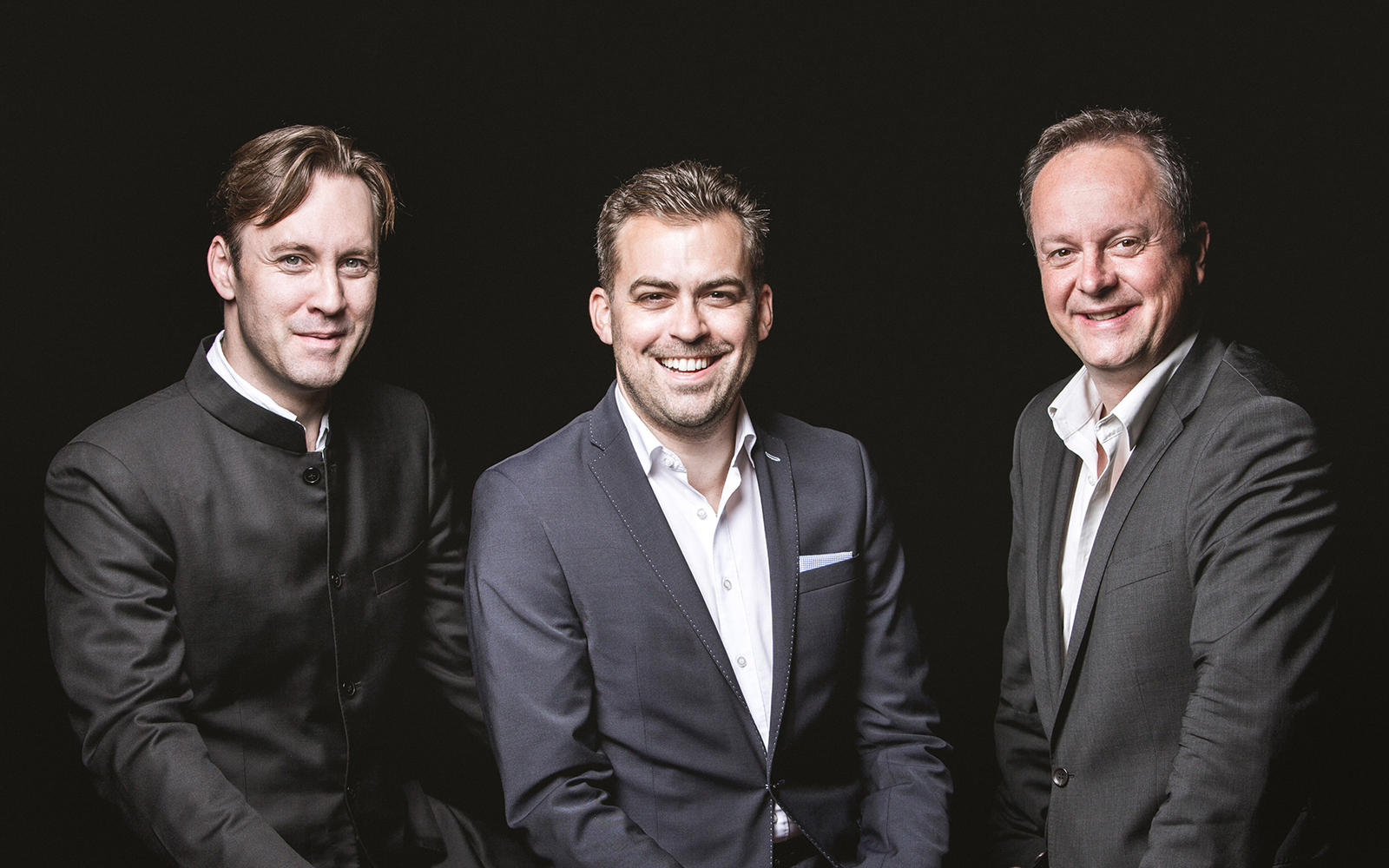
Phaeton Piano Trio III / Le Trio Phaeton III
$20.00 à $100.00
This event is included with your pass! / Cet événement est inclus dans votre passeport !
Click here to buy your Pass! / Cliquez ici pour acheter votre passeport !
Phaeton Piano Trio / Le Trio Phaeton III
Monday, July 12, 2027 at 7:30 pm
Le lundi 12 juillet 2027 à 19 h 30
Friedemann Eichhorn – violin / violon
Peter Hörr – cello / violoncelle
Florian Uhlig – piano
Program / Programme
Ludwig van Beethoven – Variations on “Ich bin der Schneider Kakadu” for Piano Trio, Opus 121a (c. 1801–02; revised later)
Variations sur « Ich bin der Schneider Kakadu » pour trio avec piano, opus 121a (vers 1801–1802; révisées ultérieurement)
Camille Saint-Saëns – La Muse et le Poète for Violin, Cello and Piano, Opus 132 (1910)
La Muse et le Poète pour violon, violoncelle et piano, opus 132 (1910)
Antonín Dvořák – Piano Trio No. 4 in E minor, Opus 90, B. 166, “Dumky” (1890–91)
Trio avec piano no 4 en mi mineur, opus 90, B. 166, « Dumky » (1890–1891)
Program note: Beethoven begins with a simple theatrical tune and turns it into a sequence of increasingly imaginative variations. The contrast between its grave introduction and playful theme is part of the work’s charm. In La Muse et le Poète, Saint-Saëns gives violin and cello prominent, intertwined roles, with the piano completing their conversation. Dvořák builds this trio from six dumky, each moving between reflective song and lively dance. Rather than following a conventional four-movement design, the work unfolds as a succession of sharply contrasting moods. Dvořák himself played the piano at its premiere in Prague in 1891.
Note de programme : Beethoven part d’un simple thème théâtral qu’il transforme en une succession de variations toujours plus imaginatives. Le contraste entre l’introduction solennelle et le thème enjoué contribue au charme de cette œuvre. Dans La Muse et le Poète, Saint-Saëns confie au violon et au violoncelle des rôles de premier plan qui s’entrelacent, tandis que le piano vient compléter leur dialogue musical. Dvořák construit son trio autour de six dumky, chacune alternant entre chant méditatif et danse animée. Plutôt que de suivre la structure traditionnelle en quatre mouvements, l’œuvre se déploie en une succession d’atmosphères fortement contrastées. Dvořák lui-même tenait la partie de piano lors de la création de l’œuvre à Prague, en 1891.
Carleton Dominion-Chalmers Centre
Air conditioned! / Air climatisé!
Accessible entrance! / Entrée accessible! (290 Lisgar St.)
Date
Time
Venue
Carleton Dominion-Chalmers Centre
Ottawa, ON K2P 0G8 Canada
